
Portrait Du Fulton 1980
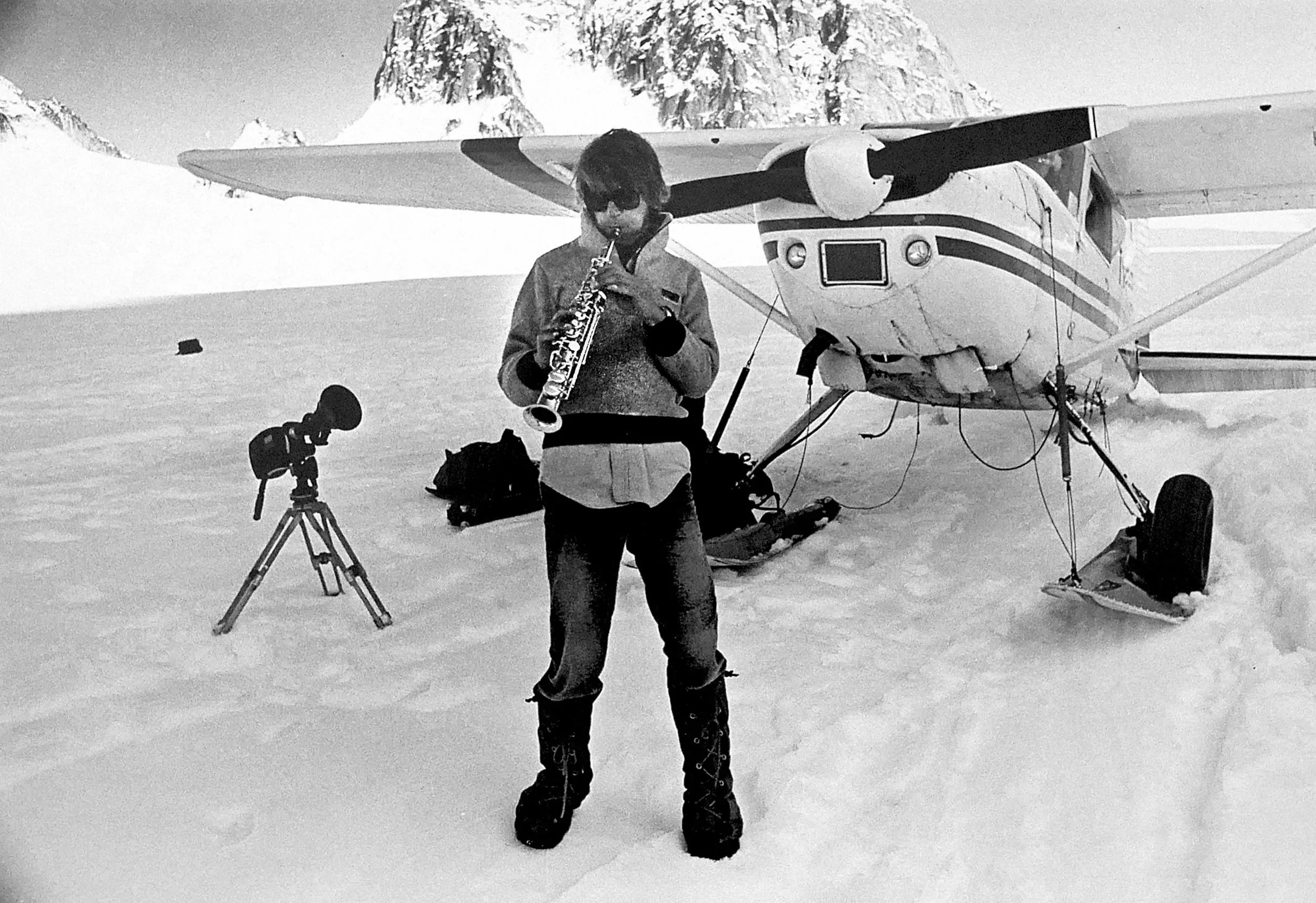
"Robert Fulton is an artist of rare complexity and depth. One uses the term 'artist' for Fulton only for lack of a better word. Germans might call Fulton a Lebenskunstler, a "life artist," because his real art form is his own life not just his enigmatic, stubbornly mute photographs, his lyrical aerial cinematography, his labyrinthine films, his dense, defiantly poetic and resolutely metaphysical prose. Fulton is a juggler and a combiner, combining ideas and images that don't really belong together into new definitions of what may well belong together."
— Lito Tejada-Flores, Author
Filmmaker, Cinematographer, Pilot, Producer, Director, Editor, Musician, Photographer, Writer and Poet
1939 - 2002
Fulton’s journey capturing images began with still photography for nearly a decade after graduating high school. By 1967, he turned increasingly to 16mm motion pictures, creating numerous one, two, and three minute experimental shorts, fusing imagery of the natural world with poetic reflections of the human condition. Fulton developed theories on the upper limit film’s ability to increase a human being’s perception of images. He later dubbed his central theory “Omnivision,” and often applied it by capturing kinetic sequences of single frames with his Bolex, later played back at 24 frames per second, challenging audiences to look “through” the image.
After building a reputation for creating compelling experimental works, Fulton built a career as a cinematic renaissance man for various commercial and documentary projects spanning a variety of genres and notable collaborators. With Roger Brown of Summit Films, Fulton would help shoot and edit campy ski films like “The Great Ski Chase.” Through the same company, Fulton also captured an insider’s portrait of counterculture author Hunter S. Thompson’s groundbreaking campaign for sheriff in 1970, though funding for the project never gained traction. The footage remained dormant for fifty years until it was discovered in a barn on the edge of Aspen, Colorado, where it eventually featured centrally in the feature documentary “Freak Power: The Ballot or the Bomb.”
Through his connections at Harvard, Fulton assisted on a number of ethnographic documentaries directed by anthropologist Robert Gardner, and later appeared twice on his public-access filmmaker interview showcase “Screening Room.” Fulton also taught filmmaking as a professor for The Chicago Art Institute, The San Francisco Art Institute, and The Carpenter Center at Harvard University. Being based out of Aspen, Colorado, he would often commute to his classes weekly via his personal Cessna airplane.
Beyond filmmaking, Fulton practiced martial arts and studied Buddhism with Geshe Wangyl, a Tibetan lama credited with bringing Buddhism to America in the 1950’s. These interests as well as many others dramatically influenced his film making. He played the saxophone and expressed a desire to make films that flowed like the notes played by famous jazz musician, Charlie Parker.
A portrait of Fulton for French TV Station Antenne 2, overlayed with one of his films, “Street Film 5.”
An advertisement Fulton acted shoot for Eastern Airlines, showcasing new flights to the Caribbean. Featuring Orson Welles as the narrator.
Fulton was also an avid aviator, learning to fly in his father's invention, an automobile with detachable wings called the “Airphibian,” at age ten. Like most of his passions, this bled into his filmmaking career. In an age before consumer-grade drones with video cameras, Fulton was a pioneer in cinematic aerial photography by mounting a 35mm motion picture camera underneath the wing of his nimble Cessna 180 named “Alfie.” After personally tinkering and perfecting his setup, he went on to capture stunning footage of natural landscapes from previously unthinkable vantage points for film and television, including the BBC docu-series, “Andes to Amazon.”
An excerpt from “Pilot Notes I: South America,” a portrait of Fulton later in life, directed by Vladimir Van Maule.
“Bob pitched his skills against the might of the Patagonian weather systems where 100 mph winds actually enabled him to fly backwards at one point - while also fighting off the potentially fatal effects of snow and ice on his single engine and windscreen. The 'white-out' effect of the great southern ice cap at the extreme tip of Patagonia was another test of skill.
He also had to take off into terrific headwinds, fly in great turbulence, film beautiful steady images, and get back before ice or lack of fuel got him.”
Since his untimely death while piloting his Cessna in 2002, Fulton’s films have been rediscovered by an enthusiastic film viewing public. The Robert E. Fulton III Film Collection and Archive was established to preserve Fulton’s works for future generations, beginning with the digitization and restoration of his personal collection of 16mm film reels. In recent years, the archive has supported a number of screenings of Fulton’s films across the world, including Harvard University, The Centre Pompidou in Paris, and Centre de Cultura Contemporania in Barcelona.